When the accusation is true
You call yourself a Christian after what you did?
The thought comes at night, and the worst part is that the list is accurate. Nobody ever showed you how Christian answered Apollyon when the charges were true.
The Pilgrim's Field Manual · In John Bunyan's own words
What John Bunyan actually wrote about spiritual attack, lost assurance, suffering, and despair, read with the Scriptures he cited, without theatrics, and with a clear line where a doctor should take over.
“Christian answers: ‘All this is true, and much more which thou hast left out,’ and adds that his Prince is ‘merciful, and ready to forgive.’”
Does this sound familiar?
You call yourself a Christian after what you did?
The thought comes at night, and the worst part is that the list is accurate. Nobody ever showed you how Christian answered Apollyon when the charges were true.
Maybe I was never really saved.
You once had peace, and now you reach for it and find nothing. Bunyan's pilgrim did the same thing on the Hill Difficulty, and Bunyan told the reader exactly what happened next.
More prayer should have fixed this by now.
You have been told it is an attack, or a lack of faith. You have not been told where Bunyan's allegory stops and where a doctor, a pastor, or a friend should step in.
You don't need louder spiritual warfare. You need what Bunyan actually wrote, the Scriptures he cited, and the honesty to know when the road calls for a doctor.
What's at stake
Bunyan named temptations "from Satan, mine own heart, and carnal acquaintance." Blaming everything on the devil leaves the heart, other people, and the body untreated.
Christian heard blasphemies he "verily thought had proceeded from his own mind." Without that scene, a hated thought feels like a chosen one.
Bunyan's low places are spiritual pictures. Depression is an illness, treated with therapy, medication, or both. Confusing the two keeps people from help.
Bunyan's armoury holds Scripture, faith, truth, and "ALL-PRAYER." Nothing in it binds spirits or commands objects.
A different way to see it
In Doubting Castle, beaten and without bread, Christian and Hopeful prayed from about midnight until almost daybreak. Then Christian remembered what he had carried all along: a key called Promise.
The kit is built on that picture. Christian carried or received five things on the road: the armour and All-Prayer, the roll with a seal, the book, the key called Promise, and a fellow pilgrim. Each core reads one of them in Bunyan's own words.
I have a Key in my bosom called Promise, that will, I am persuaded, open any Lock in Doubting Castle.
Try it now
These answers are copied word for word from the Quick-Answer Index. In the kit, each one takes you to the page where it is explained with its sources.
“I feel under attack and can't answer”
Answer
Christian answered Apollyon's accusations with “All this is true,” and then with forgiveness. Agree with the facts, not the verdict.
The index covers 48 situations like these.
The kit's method
The framework, what the pilgrim carried, is the kit's own, built from Bunyan's text. Every paragraph is also labeled as documented fact, interpretation, or opinion.
His words from public-domain editions, each quotation checked word for word against its source before layout.
All five coresThe Bible references printed beside the story, read in their own chapters, in the King James Version.
All five coresApplications are marked as interpretation or opinion, and the clinical boundary is named with NIMH and crisis lines.
Cores 1, 2, and 4Bunyan does not say so, and the story points the other way. Christian still wears the coat and the mark; he asks forgiveness and finds the roll; and when Apollyon later throws the lost roll at him as an accusation, Christian answers that he has “obtained pardon” of his Prince. What he lost was his comfort and his pass, not his Lord.
Documented factIn the arbour scene, Bunyan calls the roll “that which used to relieve him, and that which should have been his pass into the Celestial City.”
Documented factApollyon later accuses Christian: “thou didst sinfully sleep and lose thy choice thing.”
Documented factChristian answers that these infirmities he has “groaned under,” “been sorry for,” and “obtained pardon of my Prince.”
InterpretationThis is the kit's reading of the story, not a doctrine Bunyan states in the scene. It fits his picture: the pilgrim who loses assurance is still on the road, still clothed, and still able to go back for what he dropped.
OpinionIf your assurance is gone, do not conclude from the loss alone that you were never on the road. Do what Christian did.
Source: John Bunyan, The Pilgrim's Progress, Part 1, Project Gutenberg eBook #131, with the full reference in the Core 2 sources.
Anatomy of an item
The short answerThe essentials in a few lines, ready when you need them.
Every paragraph labeledDocumented fact, interpretation, or opinion: you always know which is which.
Where the reading stopsThe kit's application is marked, so Bunyan is never made to say more than he wrote.
What to do with itA recommendation, labeled as opinion, so you can weigh it.
The sourceEvery quotation checked word for word, with the full reference.
What's inside
Core 146 pages
The enemy in Bunyan's allegories, the fight with Apollyon, the Valley of the Shadow of Death, Ephesians 6, and what spiritual attack is not
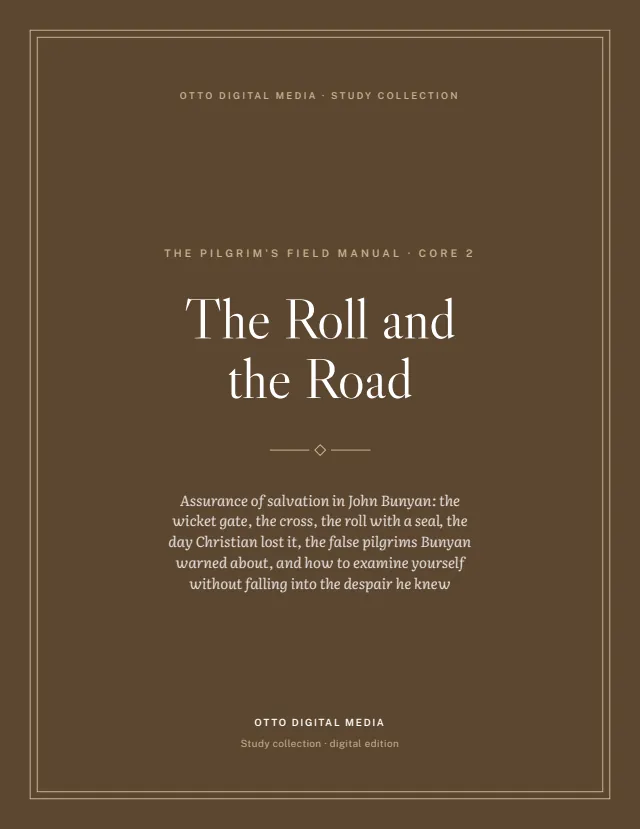
Core 239 pages
The wicket gate and the cross, the lost roll, the false pilgrims, election, and self-examination without despair
Core 342 pages
The arrest of 1660, twelve years in jail, Elizabeth Bunyan before the judges, the valley in both parts, and Bunyan's Advice to Sufferers
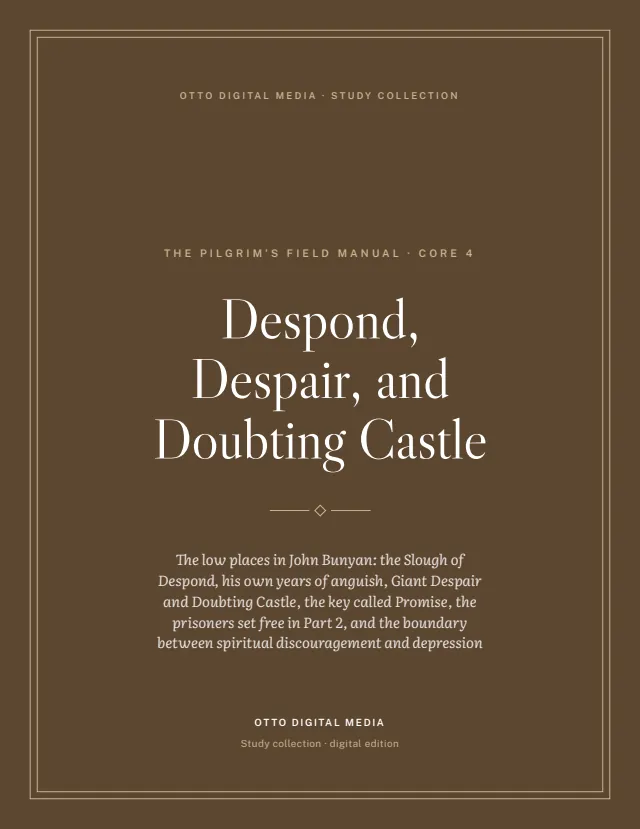
Core 439 pages
The Slough of Despond, Bunyan's own anguish, Giant Despair, the key called Promise, and the boundary with depression
Core 539 pages
Who Bunyan was, what he believed about law, grace, and justification, open communion, Vanity Fair, and how to read the book well
Look inside
Tap an image to see it larger.
Swipe to see more pages →
The difference
Proof of rigor
Bunyan is quoted from public-domain editions: the Project Gutenberg texts and George Offor's edition of the Works. Every quotation was checked word for word by script before each build, and every footnoted claim against its source.
Bunyan was not arrested under the Conventicle Act: his arrest in 1660 came before the Acts of 1662 and 1664.
Bunyan did not blame every temptation on Satan; he named "Satan, mine own heart, and carnal acquaintance."
The key called Promise was not a new gift in the dungeon: Christian had carried it all along.
Bunyan's editors disagree on when The Pilgrim's Progress was begun and on the date of his release order. The kit gives both.
Honestly
Before you decide
This kit reads it with Grace Abounding, The Holy War, Bunyan's prison writings, and Part 2, and ties each scene to the verses printed beside it.
Every item begins with a short answer in plain English, and the glossary defines 53 terms with their most common misuse.
The videos raise questions. The kit is the reference work: the source for every claim and the exact page when you need it.
No. It teaches no rituals and never treats illness as a demon. It reads what Bunyan actually wrote, and names where his allegory stops.
It can help you understand Bunyan's low places, but it is not treatment. Core 4 explains when to see a doctor, and gives crisis lines.
He wrote about accusation, lost assurance, a family under strain, and despair. The kit keeps his words and explains the seventeenth-century setting.
You have 7 days to ask Hotmart for a refund, as set out below.
Guarantee
If the kit isn’t right for you, ask for a refund within 7 days of purchase and you get 100% of your money back, even if you’ve already downloaded the PDFs. No reason needed.
Request it on Hotmart under My Purchases, or email contact@ottodigitalmedia.com. Read the Refund Policy
Your complete Field Manual
Open the index, find your situation, read the answer, and tap the reference: you land on the page with the full discussion and its sources. If you prefer to read in order, the workbook's diagnostic suggests a path.
Everything you get
Digital product in PDF. Educational material, not a substitute for medical, psychological, or pastoral care.
7-day money-back guarantee · Payment processed by Hotmart
Frequently asked questions
Thirteen PDF pieces in US Letter size (the visual pieces in landscape, also as images) and a complete edition that brings them together in one 275-page PDF.
Yes. It is a US Letter PDF, and the workbook's lines are meant for notes on paper or on a tablet.
No. It is educational material and does not replace medical, psychological, or pastoral care. If you are thinking of ending your life, call or text 988 in the United States or 9-8-8 in Canada, call Samaritans on 116 123 in the United Kingdom or Lifeline on 13 11 14 in Australia, or call your emergency number.
Public-domain texts: The Pilgrim's Progress Part 1 and Grace Abounding from Project Gutenberg, and George Offor's 1854 edition of the Works for Part 2 and the other treatises. Scripture is quoted from the King James Version.
No. It is an independent work, not affiliated with or endorsed by the Bunyan Meeting, the John Bunyan Museum, or any institution devoted to John Bunyan.
It reports what Bunyan believed, including his Reformed convictions and his open communion practice, and it presents disputes, such as the one with other Baptists, from the sources it could verify.
As soon as your payment is confirmed, Hotmart emails you access to download the PDFs. They also stay in My Purchases in your Hotmart account.
You have 7 days from purchase to ask for a full refund, with no reason needed, even if you’ve already downloaded the files. Ask on Hotmart or by email; the details are in the Refund Policy.
Email contact@ottodigitalmedia.com from the address you used to buy. We reply by email.
Bunyan's own words, the Scriptures he cited, and an honest line where care takes over, in 13 pieces.
Get the Field Manual — $49.90Navigable PDF · 13 pieces · 272 pages